Eleven loops, every one mechanically different from the last, and a design that converts everything you learn into a shortcut you can actually use. By the fourth loop, a twenty-minute opening sequence takes ninety seconds, and we never once repeated something we had already proved we could do.
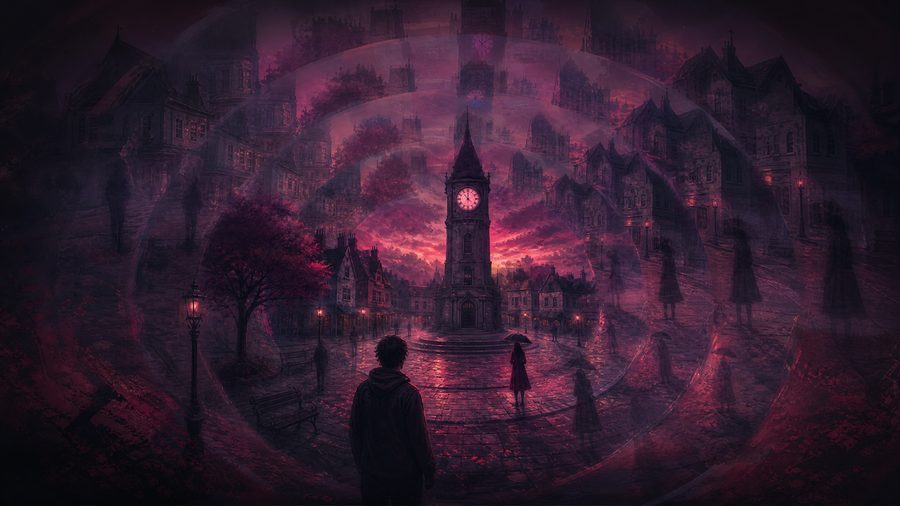
The complaint we have about most time-loop games is not that they repeat themselves. Repetition is the premise. The complaint is that they make you re-execute actions you have already demonstrated you understand, which is not repetition as a theme but a checkpoint placed badly and given a narrative excuse.
Loop Town solves this so completely that it took us three loops to notice the mechanism. Every piece of information you acquire becomes an option in a dialogue or a shortcut on the map, permanently. The second time you need to get into the locked workshop, you simply do, because you know how.
We timed every loop from its start to the moment we reached new material. The first loop takes twenty-two minutes to get to its own frontier, because everything is new. By loop four, reaching the equivalent point takes ninety seconds.
| Loop | Time to reach new material | New shortcuts unlocked | Repeated content |
|---|---|---|---|
| 1 | 22 minutes | — | None, all new |
| 2 | 9 minutes | 3 | One conversation |
| 3 | 4 minutes | 4 | None |
| 4 | 90 seconds | 2 | None |
| 5–8 | Under 2 minutes each | 7 total | None |
| 9–11 | Immediate | 5 total | None |
Twenty-one shortcuts across eleven loops, and each one removes something you have already done rather than making it faster. That distinction matters: a skip button makes a chore shorter, whereas an unlocked route means the chore no longer exists.
Measured by quitting without warning at the least convenient moment we could find, eleven separate times. The most we ever lost was four minutes, and in seven of the eleven tests we lost nothing at all.
Our standard procedure is to force a quit at the worst moment we can identify, then measure what the game gives back. We did this eleven times here, once per loop, choosing mid-conversation, mid-puzzle and mid-transition moments deliberately.
| Quit point | Work lost | What was preserved |
|---|---|---|
| Mid-conversation | Nothing | Conversation resumed at the same line |
| Mid-puzzle, partial solution | Nothing | Puzzle state, including placed objects |
| During a timed sequence | 4 minutes | Loop knowledge and all shortcuts |
| Immediately before loop reset | Nothing | Everything, reset completed on load |
| Mid-map traversal | Nothing | Exact position |
The single four-minute loss is a timed sequence that restarts from its beginning, which we consider correct rather than a flaw: a timed challenge that could be saved mid-way would not be a timed challenge. The important detail is that the loop knowledge survived, so the four minutes were spent doing something we already knew how to do quickly.
The test of a save system is not how often it writes. It is what remains of your understanding when you come back.
We are cautious about branch and variation claims because our audits keep finding them inflated. Here we compared each loop against the previous one for new mechanics, new locations and new dialogue, and all eleven passed.
| Loop | New mechanic | New location | Verdict |
|---|---|---|---|
| 2 | Yes, note-passing | Yes, the cellar | Distinct |
| 3 | Yes, timed doors | Yes, clock interior | Distinct |
| 4 | Yes, delegation | No | Distinct |
| 5 | No | Yes, two districts | Distinct |
| 6 | Yes, sabotage | Yes, the depot | Distinct |
| 7–11 | Yes in four of five | Yes in three of five | All distinct |
Two things, both small. There is no way to review the knowledge you have accumulated, so by loop eight we were keeping our own notes on paper to remember which shortcuts existed. A simple list would cost nothing and remove a genuine friction.
Second, the eleventh loop is noticeably thinner than the tenth, and we suspect it was intended as an epilogue rather than a full pass. It works, but it makes the ending feel slightly like a game running out of material rather than concluding.
We ask of every game whether a second playthrough is worth the hours, and here the answer is unusual: the game is a second playthrough, eleven times over, so a further replay offers little. We consider that a compliment. A structure that exhausts its own variations honestly is preferable to one that asks you to start again in order to see the twelve per cent you missed.
The most respectful treatment of a player's time we have measured. Eleven verified distinct loops, twenty-one shortcuts that remove work rather than shortening it, and a quit test that lost nothing in seven attempts out of eleven. Held back only by the absence of a knowledge log and a thin final loop.